Rear lens caps · AirTag
Canon RF rear cap with an AirTag inside
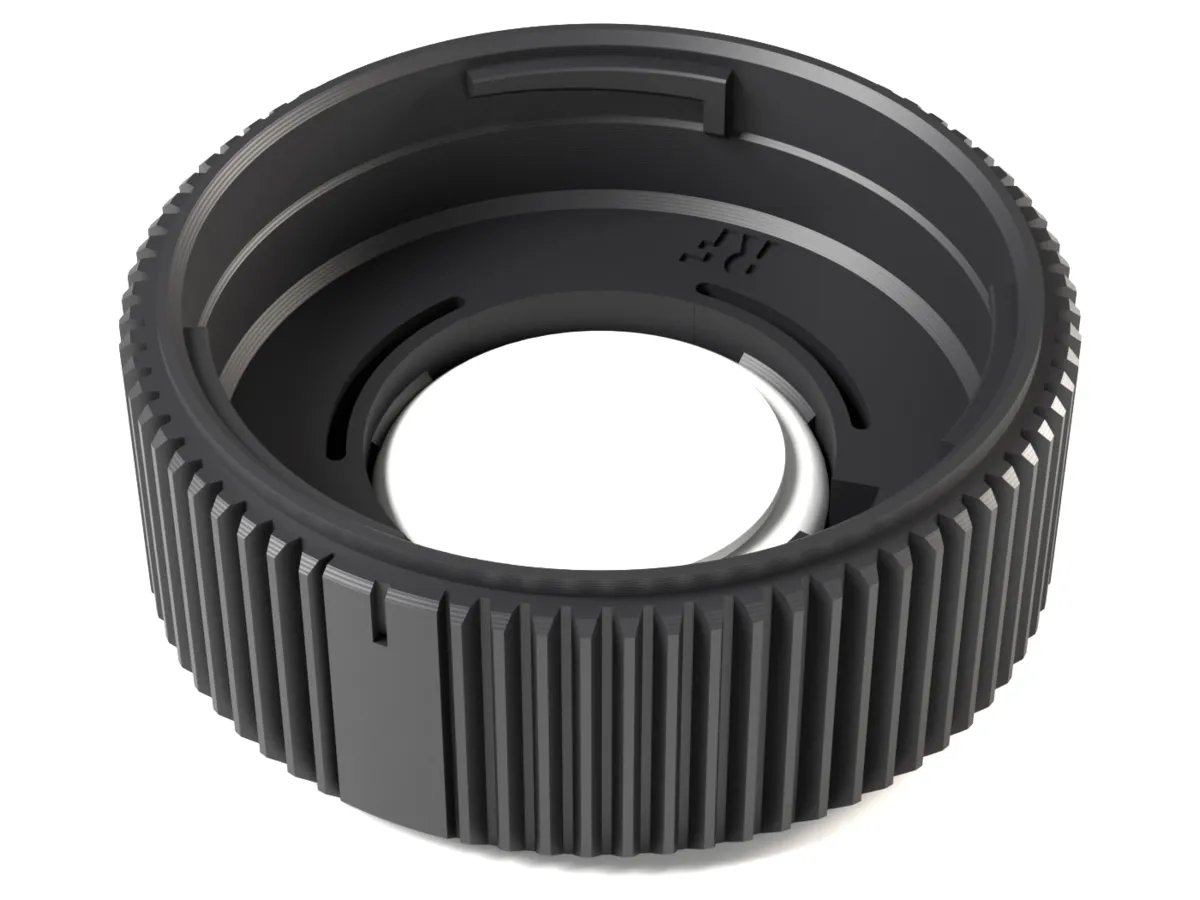
A Canon RF rear cap with an Apple AirTag hidden in its base. The tag snaps in from the inside and stays out of sight, so a lens left on set or in a rental case shows up in Find My.
One part, no screws
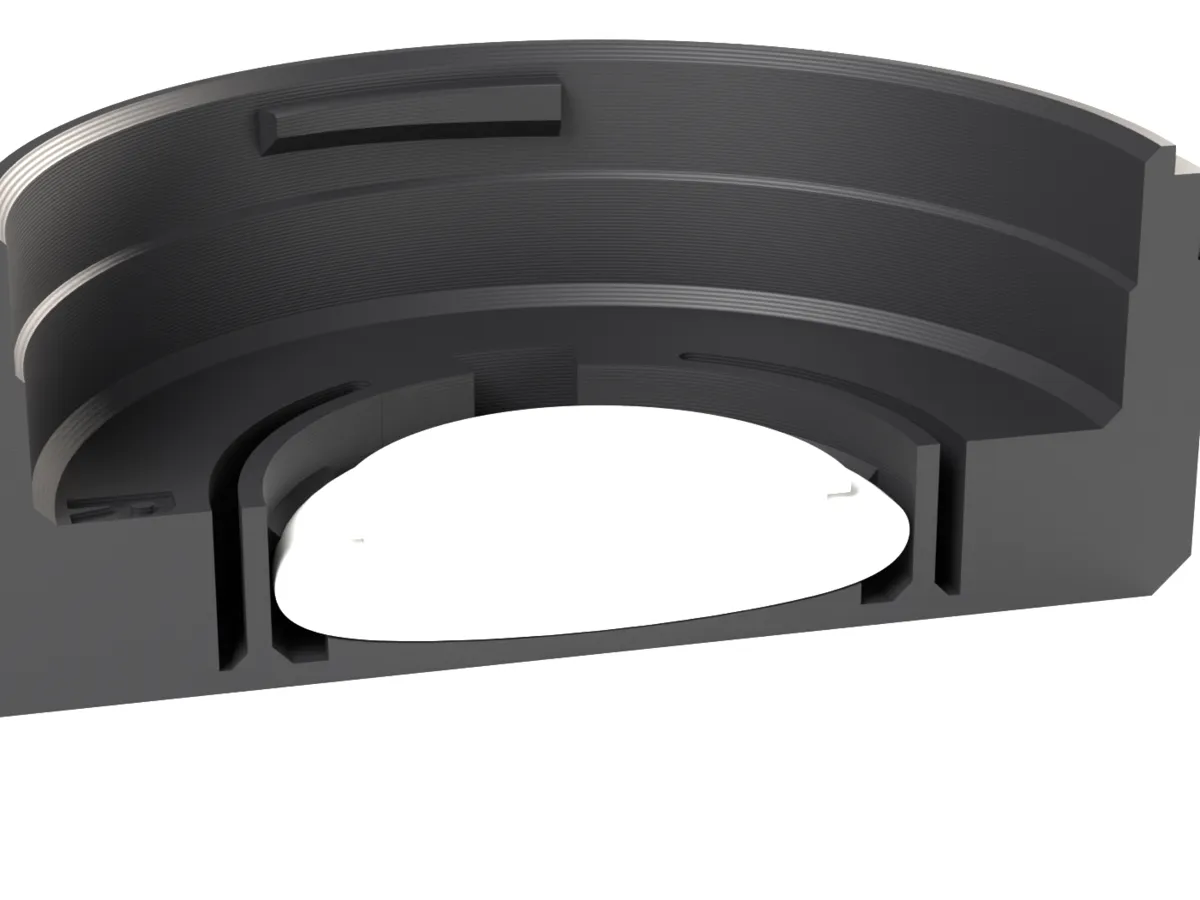
The pocket wall is one closed ring. Three segments of it, joined at both ends and backed by a slot, flex as the AirTag passes and then keep pressing on it, so it clicks in and cannot shift. A notch lets you lift it out again with a fingernail.
Signal side out
The white side of the AirTag faces outwards behind a 1.2 mm face; the steel cover faces the lens. The lens keeps its full rear room.
Prints without supports
Every part of the ring grows from the layer below, nothing is printed in mid-air. Face down on the plate like every Focus Rings cap.
Same bayonet
Three claws of different widths sit in the lens neck in Canon's own layout, so the cap goes on one way only. Then turn clockwise (looking at the face) until a lug runs onto the stop. The AirTag adds 7.3 mm of height and leaves the lens room unchanged.
Fits
- Canon RF lenses (full frame) and RF-S lenses (APS-C)
- Weather-sealed L lenses: the rim stays clear of the rubber seal around the mount
- Third-party RF-mount lenses from Sigma, Tamron, Samyang, Viltrox, Laowa and others
| Mount | Canon RF |
|---|---|
| Outside diameter | Ø63.2 mm |
| Height | 24.0 mm |
| Room for the rear element | 14 mm below the rim, a little more than Canon's own cap |
| Grip | Module 0.8 gear (77 teeth) or flutes |
| AirTag | Apple AirTag, snap-in from the inside, no tools |
| Print orientation | Face down, no supports |
| Print time (slicer estimate) | about 57 min, about 21 g |
| Fit test ring | Free, about 16 min |
| Files | 3MF (body + face inlay as one object), aligned STLs, printing guide |
Print times are Bambu Studio estimates for an X1C with a 0.4 mm nozzle and 0.20 mm layers. Not every lens has been tested: print the free fit test ring first.
Print and fit
- Print the free fit test ring in the generator. It is the bayonet zone only and done in minutes.
- Put the lens lugs into the gaps and turn clockwise (looking at the face) until it stops. It should turn smoothly and sit firmly.
- Print the cap face down on the build plate, no supports. Two-colour faces: keep body and inlay as one object and give each part a filament.
- Press the AirTag in from the inside, white side towards the face, until the three tabs click.
Questions
How is the AirTag held without screws or glue?
By a closed snap ring: three segments flex slightly as the AirTag passes, then their nubs keep pressing on it above its widest point. If the click is too stiff or too loose on your printer, write to us and we send a different nub size.
Does the AirTag still work inside the cap?
AirTags work through plastic, and the white side faces outwards behind a thin face. Range depends on what is around the lens case, as with any AirTag.
Which lenses does the Canon RF AirTag cap fit?
Canon RF lenses (full frame) and RF-S lenses (APS-C); Weather-sealed L lenses: the rim stays clear of the rubber seal around the mount; Third-party RF-mount lenses from Sigma, Tamron, Samyang, Viltrox, Laowa and others. Room for the rear element: 14 mm below the rim, a little more than Canon's own cap.
Has this Canon RF rear cap been tested on a lens?
Not yet on a Canon RF lens. The bayonet is measured from caps that fit real lenses, the lock uses the settings tuned in our print tests on other mounts, and every file passes a layer-by-layer support check. Print the free fit test ring first: it is the bayonet zone only, done in minutes, and shows on your lens whether the cap will turn on and lock.
Does it need supports?
No. The cap prints face down on the build plate. Every overhang is at most 50°, and the claws have sloped undersides that build up layer by layer.
Which filament should I use?
Rings without clamps and lens caps: PLA or PETG, 0.4 mm nozzle, 0.20 mm layers, your usual walls. PETG is a little tougher if the cap lives in a bag.
Why gear teeth on a rear cap?
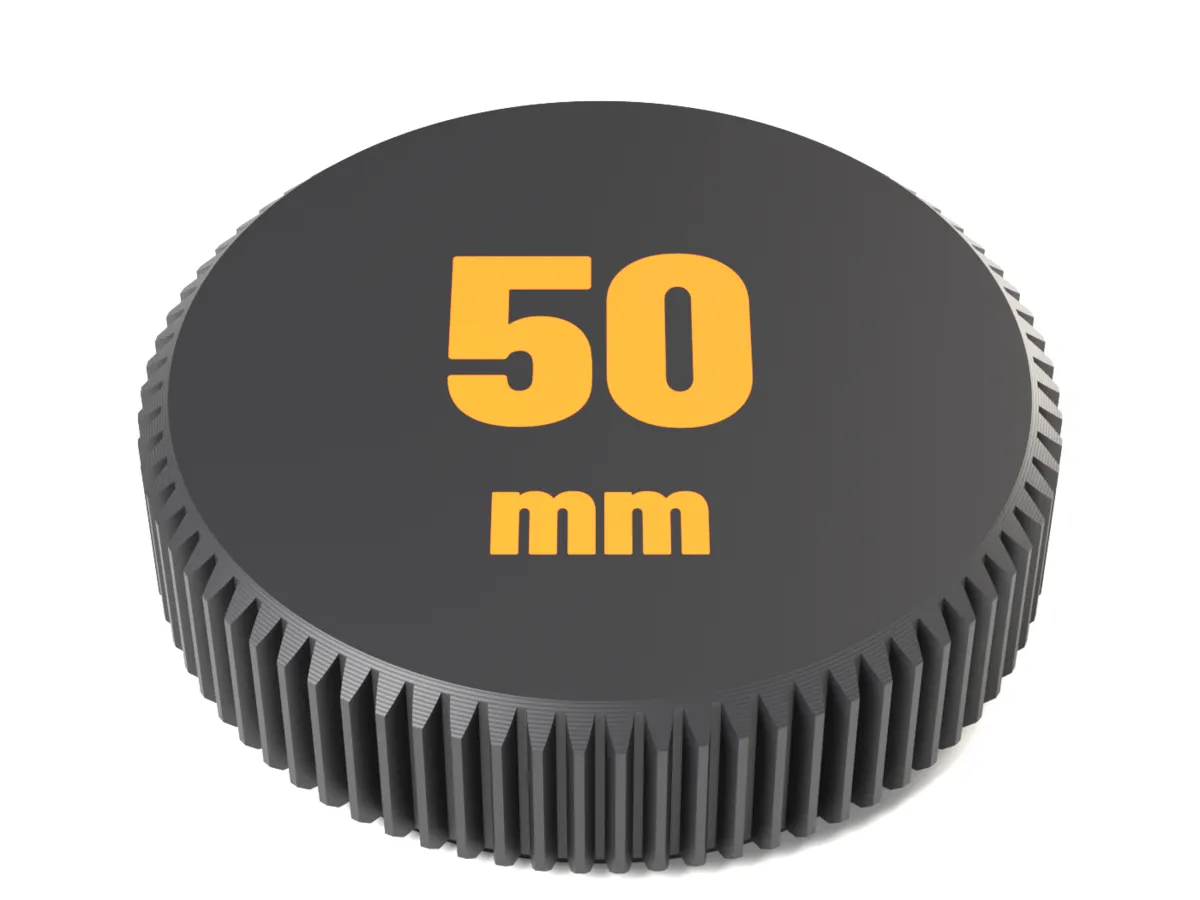
They are the same module 0.8 teeth as our focus rings, so the cap matches your follow focus gear and grips well with gloves. The vertical teeth also hide layer lines. Prefer something smoother? Pick the flutes grip.